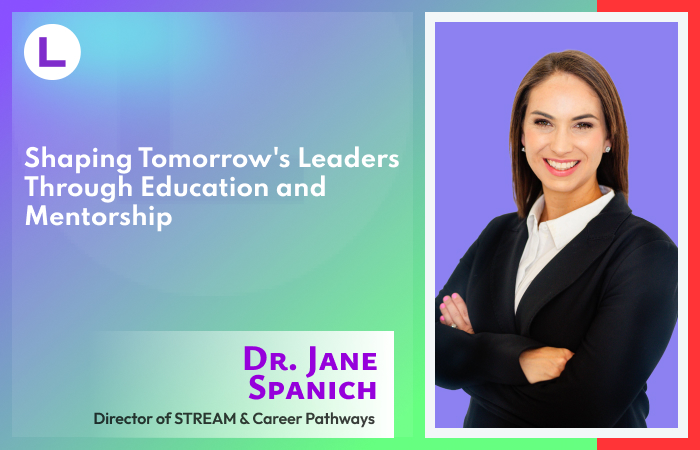
As the Director of STREAM at Cardinal Gibbons High School, Dr. Jane Spanich has dedicated her career to empowering students through innovation, leadership, entrepreneurship, and interdisciplinary learning. With expertise spanning education, theology, STEM, artificial intelligence, and student development, she is committed to helping learners discover opportunities, build meaningful connections, and prepare for an ever-evolving future. In this exclusive interview with The Leaders 360, Dr. Spanich shares her educational journey, the vision behind STREAM, and her insights on preparing the next generation of leaders for success.
Educational Leadership Journey
We were interested in learning more about Dr. Jane Spanich’s professional background and career journey, so we asked her to briefly introduce herself and share what shaped her path.
Dr. Jane Spanich: I am the Director of STREAM at Cardinal Gibbons High School, my alma mater, where I lead interdisciplinary initiatives connecting science, technology, religion, engineering, the arts, and mathematics. I also serve as a Robotics Coach and lead the school’s Career Pathways Program, which encompasses EMT, Allied Health Sciences, Engineering, Business, Digital Video Technology, and Computer Science with AI. My professional journey has been shaped by a longstanding interest in the intersection of education, theology, innovation, and human development. Raised in South Florida, I attended St. Anthony’s Catholic School and Cardinal Gibbons High School, experiences that profoundly influenced my understanding of Catholic education and the importance of forming the whole person. I remain actively engaged in my Catholic community, including serving as a Eucharistic Minister.
I hold a Bachelor’s degree in International Affairs from Florida State University, a Master’s in Liberal Arts from Rollins College, and a Ph.D. in Practical Theology from Saint Thomas University. My interdisciplinary academic background has allowed me to approach education not simply as the transmission of knowledge, but as an opportunity to examine how knowledge, ethics, faith, culture, and human flourishing intersect. During my undergraduate studies, I also completed an internship with the U.S. Congressman, an experience that provided an early introduction to public service, institutional leadership, and civic engagement.
My work with students has extended beyond the traditional classroom. At both St. Thomas Aquinas High School and Cardinal Gibbons High School, I have supported students participating in the Miami Herald Silver Knight program, helping students navigate the process of identifying meaningful service, articulating their experiences, and presenting their work to a broader community.
In 2027, I will be honored in Bangkok, Thailand, with the Executive Global Impact Award, recognizing my contributions to education and leadership. I was previously named one of the “Top 10 STEM Directors of 2024” by Education Technology Insights and have also been recognized as an Influential Woman for my contributions to education and leadership. For ten years, I tutored foster children through a South Florida organization, an experience that continues to inform my understanding of educational opportunity, mentorship, and the responsibility educators have to students whose circumstances may differ from their own.
I am also a published scholar with more than 15 academic publications. My scholarship has included work highlighted through Boston University’s Practical Theology platform, as well as a recent review of Peter J. Bellini’s Artificial General Intelligence (AGI) and the Image of God: Can Machines Attain Consciousness and Receive Salvation? My scholarly interests include emerging questions in machine theology, artificial intelligence, ethics, and the theological implications of technological development.
I am a STEM-certified teacher through the National Institute for STEM Education. My current areas of academic and professional inquiry include AI Ethics, Health Sciences, Marine Life Sciences, Artificial General Intelligence, Robotics, STREAM, Practical Theology, Quantum Theory, Cosmology, and Phenomenology. While my professional life encompasses education, scholarship, leadership, and innovation, I consider my most important roles to be those of mother, daughter, sister, and wife. I remain grateful for the people who have shaped my journey and for the opportunity to continue learning alongside my students and colleagues. When I have time for myself, I can often be found returning to one of my favorite literary worlds: The Lord of the Rings.
Passion for Education and Student Development
We wanted to understand what inspired Dr. Jane Spanich to build a career in education and student development, so we asked about the motivation behind this journey.
Dr. Jane Spanich: My path into education was shaped by a combination of academic mentorship, personal relationships, and a growing recognition that education can be a powerful vehicle for human formation. My professors at Rollins College played an important role in shaping my intellectual development and ultimately influenced my decision to pursue education more deeply. Throughout my career, I have also been fortunate to encounter mentors who were willing to challenge my thinking, encourage my curiosity, and recognize potential in me before I fully recognized it in myself.
That experience has profoundly influenced how I work with students. I find student development particularly meaningful because students are at a formative stage of their lives. They are developing intellectually, spiritually, socially, and professionally, and they are often capable of far more than they initially believe. I enjoy creating environments in which students can ask difficult questions, explore unfamiliar disciplines, make mistakes, and discover new possibilities. Some of the most rewarding moments in education occur when a student begins to see a possibility for himself or herself that previously seemed inaccessible. It is a privilege to accompany students during that process. I do not see myself as someone who has all the answers. Rather, I hope to model intellectual curiosity, continued learning, and a willingness to ask better questions.
The Vision Behind STREAM Education
We were interested in learning more about the STREAM program led by Dr. Jane Spanich, so we asked her to share the vision behind the initiative.
Dr. Jane Spanich: My vision for STREAM at Cardinal Gibbons is to develop an academically rigorous, interdisciplinary program that remains deeply rooted in our Catholic identity. I believe the most meaningful educational experiences occur when students are encouraged to recognize connections among disciplines rather than experiencing knowledge as a series of isolated subjects. Science can raise ethical questions. Technology can challenge our understanding of humanity. Engineering can become an exercise in service. Mathematics can reveal patterns within creation. The arts can deepen our capacity for empathy and interpretation. Theology can provide a framework through which students consider meaning, purpose, dignity, and responsibility.
For me, STREAM creates a space where these conversations can occur naturally. My goal is also to cultivate a culture of trust, intellectual curiosity, collaboration, and continuous improvement among both students and teachers. I want students to develop the capacity not only to solve problems, but also to identify which problems are worth solving and to consider the human consequences of their solutions.
Interestingly, I never anticipated becoming a STEM Director. A PhD mentor who now teaches Chemistry at the college level recognized an interest and aptitude in me that I had not yet fully articulated for myself. She encouraged me, challenged me, and helped me develop a deeper appreciation for STEM, interdisciplinary learning, and innovation. That experience continues to shape my leadership philosophy. Sometimes the most significant thing an educator can do is recognize something in a student before the student can recognize it in himself or herself. Any awards I have received, I share with my students. If it wasn’t for them, I would not have received them.

Empowering Future Entrepreneurs
Supporting future entrepreneurs is an important part of student development, so we asked Dr. Jane Spanich how she helps students interested in business and entrepreneurship.
Dr. Jane Spanich: I am fortunate to work with exceptional colleagues and teams, and that collaboration is foundational to what we accomplish. One of the central goals of our Career Pathways work is to move learning beyond the boundaries of the classroom and into authentic professional environments. We do this through guest speakers, field experiences, internships, mentorships, partnerships, and interdisciplinary Projects. I particularly enjoy serving as a bridge between students and professionals—including CEOs, CFOs, CCOs, entrepreneurs, scientists, engineers, and other industry leaders. These relationships provide students with an opportunity to encounter professionals not simply as titles or positions, but as people who have navigated their own educational and professional journeys.
I also place considerable emphasis on professional communication. A student may have an extraordinary idea, but the ability to communicate that idea effectively is itself an essential professional skill. I sometimes sit with students as they draft an email, make a phone call, or prepare for a meeting because I want them to experience that process firsthand. I tell students that a well-written email can open a door. They should not be afraid to introduce themselves, ask a thoughtful question, request a meeting, or respectfully pursue an opportunity. Networking, at its best, is not simply about what someone can do for you. It is about building authentic relationships in which both people have the opportunity to learn and contribute.
Challenges in Career Planning
We wanted to gain Dr. Jane Spanich’s perspective on career readiness, so we asked about the common challenges students face when planning their careers.
Dr. Jane Spanich: Students encounter a number of challenges, but some of the most significant are confidence, belonging, communication, literacy, and networking. Before students can effectively advocate for themselves, they need to understand that they have a legitimate place in the conversation. I often tell students: You belong on your campus. You belong in the room. You belong at the table. That sense of belonging can become a foundation for confidence. It gives students permission to ask questions, contact professionals, seek mentorship, and pursue opportunities that may initially feel intimidating. I also believe that career preparation should not end at graduation. Schools have an opportunity to maintain meaningful relationships with alumni and to use data responsibly to better understand students’ educational and professional trajectories. At my current school, I have learned a great deal from our Vice Principal about the importance of matriculation data and institutional follow-through. Thoughtful data collection allows educators to move beyond anecdotal impressions and ask more meaningful questions about student outcomes and how institutions can continue to support graduates. Ultimately, I believe student development requires both relationships and evidence: we need to know our students personally, while also being willing to examine the data that helps us understand their broader experiences.
Preparing Students for Tomorrow’s Workforce
As workforce demands continue to evolve, we were interested in her insights on education, so we asked Dr. Jane Spanich how schools can better prepare students for the future.
Dr. Jane Spanich: Schools must recognize that preparation for the future cannot be reduced to a single course, program, or career fair. Students need repeated opportunities to encounter ideas, professionals, technologies, organizations, and experiences that expand their understanding of what is possible. Teachers can play an important role by intentionally bringing opportunities into the classroom—through professional organizations, universities, internships, competitions, research opportunities, guest speakers, service experiences, and industry partnerships. Schools can also create structures that make these opportunities more accessible. This includes communicating opportunities consistently, engaging parents and alumni, developing relationships with universities and professional organizations, and creating committees or teams dedicated to career development and external partnerships. One lesson I have learned throughout my career is that people are often more willing to help than students realize. If you reach out thoughtfully and respectfully, many people will respond because they remember what it was like to be a student looking for someone to open a door. Sometimes all a student needs is someone to say, “Come in.” And if there is no chair at the table for that student—or for someone on your team—then I believe our responsibility is to find one. Educational leadership is not simply about occupying a position at the table. It is also about recognizing who is missing and creating pathways for others to participate.
Career Advice for Future Leaders
We wanted to hear Dr. Jane Spanich’s advice for the next generation, so we asked what guidance she would offer students preparing for their future careers.
Dr. Jane Spanich: My advice is simple, although putting it into practice requires discipline. Initiate the meeting. Send the email. Meet the deadline. Get a mentor. Ask the question. Learn to communicate clearly and respectfully. Build relationships before you need them. Find mentors and earn their trust. Maintain a working résumé. Continue reading. Write. Learn how to evaluate scholarly and professional sources. Cite the people whose ideas have influenced your thinking. Be willing to enter rooms where you are still learning. Remember the people who have helped you. Celebrate their accomplishments. Remember birthdays and important milestones. Treat administrative staff, teachers, executives, custodians, professors, interns, and CEOs with the same basic dignity and respect. Make your team stronger. If someone makes a mistake, practice discernment and grace. If expectations are unclear, communicate with them. If you see an opportunity to help someone else, do it.
Meet with your guidance counselors. Connect with former teachers. Explore internships. Attend board meetings when appropriate. Ask questions of professionals. Join organizations. Read beyond your required assignments. Take care of your health and your family. Spend time outside. Garden. Spend time in the library. Remain curious. And do not be afraid to advocate for yourself. Ask for the opportunity. You do not need to have your entire life mapped out at eighteen, twenty-two, or even thirty. What matters is that you continue developing the intellectual curiosity, character, relationships, and professional habits that allow you to recognize opportunities when they appear. Throughout my own career, some of the most meaningful opportunities have emerged from unexpected places—a professor who encouraged me, a mentor who believed in me, a student who asked an interesting question, or an email that I almost did not send.
So my greatest advice is: Do the work. Stay curious. Remain humble. Build relationships. Serve others. Keep learning. And when you eventually find yourself at the table, remember to listen and make the students the priority.
Also Read: