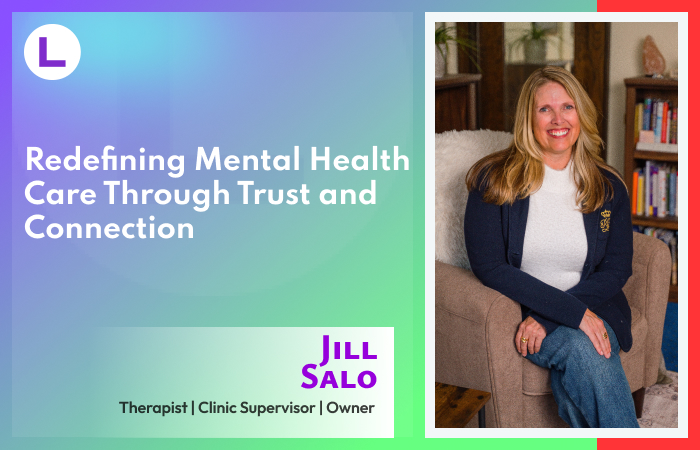
As the owner of Aurora Lake Mental Health, Jill Salo has dedicated her career to helping individuals navigate trauma, addiction, anxiety, and life’s many transitions through compassionate, client-centered care. With a strong foundation in trauma-informed therapy, clinical leadership, and EMDR-based approaches, she is committed to creating safe spaces where healing, growth, and resilience can thrive. In this exclusive interview with The Leaders 360, Jill shares her professional journey, her vision for mental health care, and her insights on supporting both clients and future mental health professionals.
A Journey of Healing
We were interested in learning more about Jill Salo’s professional background and career journey, so we asked her to briefly introduce herself and share the experiences that have shaped her path.
Jill Salo: I’m a licensed professional clinical counselor and licensed alcohol and drug counselor, as well as the owner of Aurora Lake Mental Health in Excelsior, Minnesota. My career has been rooted in trauma-informed care, with a strong emphasis on EMDR and relational approaches to healing.
I first began my professional journey as a high school counselor. I’ve always enjoyed helping others, and it was always fun to watch students grow into who they were meant to become. I especially loved working with students struggling with grades, as it seemed to never be about motivation as it was about lack of resources or education about how to make things better in their lives. To the outside world, maybe they looked lazy or that they were having too much fun, but usually they really were usually stuck. They didn’t know what to do, so they called a friend. It’s important to recognize that everyone is trying the best they can with the information they have, even the students–even their parents. It’s important to recognize that educators are the first line of defense when it comes to helping catch a learning disability, mental health or substance use disorder early. This is paramount for the health and productivity and happiness in a community.
I grew up in a family that was touched by addiction and mental health struggles, so when the mental and chemical health counselor was a budgetary cut at the high school where I was employed, I went back to school. My brother struggled with mental and chemical health for much of his life and did not get the help he needed. He ended up taking his own life. Because I could not imagine a scenario where not having a person educated about substance use disorders in a school district was a good idea, but I understood how budgets work. I went back to school at age 42. I do understand the difficulty school districts are in to balance a budget these days. Although I initially had the goal of staying in the school system as a trained LADC, but after the pandemic, I found that I love to work with one individual at a time, for an hour at a time, for an extended period of time. Schools are not set up for this model of help, and they have been wonderful referral sources. I made the tough decision to be a resource outside of the school system.
I’ve spent several years working in group practice settings, where I also served in leadership, creative and planning roles. Watching great supervisors at Ellie Mental Health (now Sagent Behavioral Health) and professors in the addiction studies program at St. Mary’s University of Minnesota helped motivate me to become a great supervisor. One of my favorite and most talented supervisors once told me that EMDR training was necessary for addiction counselors because trauma and addiction hold hands. Since then, I have been lucky enough to have advanced training in EMDR, anchored relational model (formerly AIR network), and complex family systems. Over time and with company changes, I felt called to create a more intentional and client-centered space, which led me to open my own practice focused on culturally competent, high-quality individualized care for adults navigating trauma, anxiety, and life transitions.
Inspired by Resilience
We wanted to understand what inspired Jill Salo to pursue a career in mental health and counseling, so we asked her about the motivation behind this meaningful journey.
Jill Salo: I’ve always been drawn to understanding human behavior and the ways people adapt to adversity. I saw how unresolved trauma and unmet emotional needs can quietly shape people’s lives, often without their awareness. That insight, combined with a desire to help people reconnect with their sense of self and agency, led me into the field. I’m especially inspired by the resilience I see in clients—people’s capacity to heal, grow, and create meaningful change when given the right support.

A Vision for Better Care
We were interested in learning more about Jill Salo’s vision for Aurora Lake Mental Health, so we asked what guided her in establishing the practice.
Jill Salo: The vision behind Aurora Lake Mental Health was to create a calm, grounded, and clinically excellent environment where clients feel both safe and empowered. I attempted to get a contract with all insurance companies so that anyone who wanted help could get it. I wanted to move away from high-volume, transactional care models and instead offer thoughtful, trauma-informed therapy that prioritizes depth, consistency, and trust. I also wanted a practice that supports clinicians in doing their best work—where quality care, professional integrity, and ongoing development are central values.
Another way we would like to help the community is to create a positive experience with the flow of scheduling. Initially, we started practicing in Excelsior with just one office. We are now in the process of expanding to other potential offices in the western suburbs and are currently looking at a few around the Hopkins and Minnetonka area to help with availability in the community. Our goal is for clients to be able to get onto the website, create a client portal and pick out an appointment with a clinician within 3 days. We hope that online, self scheduling options will eliminate a barrier for clients attempting to get care.
Understanding Trauma-Informed Care
We wanted to gain a deeper understanding of Jill Salo’s approach to mental health care, so we asked what trauma-informed care means to her and why it is so important today.
Jill Salo: Trauma-informed care means recognizing that many behaviors, symptoms, and coping strategies are rooted in past experiences of overwhelm, threat, or unmet needs. It’s about approaching clients with curiosity rather than judgment and creating a therapeutic environment that emphasizes safety, choice, collaboration, and empowerment. In today’s world—where people are navigating chronic stress, societal pressures, and increasing rates of trauma exposure—it’s essential that mental health care acknowledges these realities. Trauma-informed care shifts the question from “What’s wrong with you?” to “What happened to you?” and that shift is profoundly impactful.
Guiding Future Clinicians
As a clinic supervisor, Jill Salo plays an important role in developing future professionals, so we asked what qualities she encourages in the next generation of mental health practitioners.
Jill Salo: I encourage clinicians to develop strong self-awareness, clinical humility, inclusivity, and the ability to tolerate uncertainty. Technical skills are important, but the ability to be present, attuned, and ethically grounded is what truly supports effective therapy. I also emphasize ongoing learning, openness to feedback, and maintaining clear professional boundaries. Finally, I encourage clinicians to care for themselves—sustainable practice requires attention to burnout, balance, and personal well-being.

Challenges in Mental Health Care
We were interested in her perspective on the evolving mental health field, so we asked Jill Salo about the challenges mental health professionals face today and how the industry can address them.
Jill Salo: Clinicians today are facing high levels of burnout, administrative burden, and increasing demand for services, often within systems that don’t adequately support them. Reimbursement challenges and insurance barriers can also limit both access to care and clinician sustainability. To address this, the industry needs to prioritize clinician well-being, reduce unnecessary administrative complexity, and improve reimbursement structures. There also needs to be greater transparency and flexibility in insurance credentialing, as well as increased support for private practice models that allow for more personalized care.
Taking the First Step Toward Therapy
We wanted to hear Jill Salo’s advice for individuals considering therapy, so we asked what guidance she would give to someone seeking therapy for the first time.
Jill Salo: I would encourage them to approach therapy with curiosity rather than pressure. You don’t need to have everything figured out or even know what you want before you start—therapy is a space to explore, not perform. It’s also important to find a therapist who feels like a good fit; the relationship matters just as much as the method. Give yourself permission to take that first step, knowing that seeking support is a sign of strength when a person feels stuck or sad or overwhelmed, not weakness. The strength is simply knowing you want more for yourself; it’s just a matter of figuring out how to get there.
Also Read: