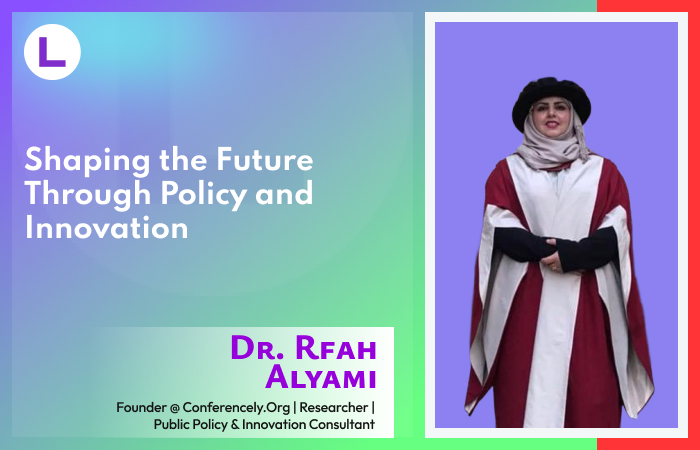
In this exclusive interview with The Leaders 360, Dr. Rfah Alyami reflects on her professional journey across education, research, public policy, and innovation, and shares how these experiences have shaped her approach to creating meaningful change. She discusses the importance of research and evidence in developing informed policies, the value of Smart Policy Design, and the challenges organizations can face when turning ideas into effective action. She also shares the inspiration behind Conferencely.org and her vision for creating stronger connections between conferences, people, research, and knowledge. Throughout the conversation, Dr. Alyami offers a thoughtful perspective on policy, innovation, continuous learning, and the importance of understanding problems before developing solutions.
A Journey From Education to Policy and Innovation
We were interested in learning more about Dr. Rfah Alyami’s professional background, so we asked her to briefly introduce herself and share her professional journey.
Dr. Rfah Alyami: I am an educational researcher, policy professional, and consultant with a longstanding interest in educational reform, leadership, research, and innovation. My professional journey began in schools, first as a science teacher and later in school leadership. Those early experiences were extremely valuable because they allowed me to understand education from the ground up — from the classroom to leadership and, eventually, to policy and system-level change.
As my career developed, I moved into higher education, research, professional development, and educational policy. I have worked as a faculty member, researcher, trainer, knowledge management director, and educational consultant, and I contributed to strategic educational initiatives within Saudi Arabia’s Ministry of Education, including the establishment and strategic planning of the Secondary School Pathways Project.
Academically, I earned my PhD in Philosophy of Education from the University of Reading in the United Kingdom, specializing in leading change and educational reform. My doctoral research examined the Tatweer School System in Saudi Arabia and explored educational reform from the perspectives of leaders and teachers.
Research has remained central throughout my career. I have presented and published work internationally on educational reform, leadership, decentralization, globalization, women’s education and leadership, policy, and, more recently, artificial intelligence in education.
Today, my interests increasingly sit at the intersection of policy, research, technology, data, and innovation. This is also why I am currently pursuing a master’s degree in Advanced Data Science and Artificial Intelligence at the University of Liverpool. I believe the next generation of public and educational policy will increasingly require us to combine human expertise with evidence, data, and emerging technologies.
Finding Purpose in Public Policy and Innovation
We wanted to understand what shaped Dr. Rfah Alyami’s career direction, so we asked what inspired her to pursue public policy and innovation.
Dr. Rfah Alyami: My interest in public policy developed naturally from my experience in education. Having worked at different levels of the education system, I came to understand that many challenges experienced in classrooms or institutions cannot be addressed at the operational level alone. Sometimes the real question is not simply, “How can we improve this practice?” but rather, “What policy, system, or decision-making structure is shaping this practice in the first place?”
My doctoral research on educational reform strengthened this perspective. Studying change within the Saudi educational context made me increasingly interested in how policy decisions move from an idea to implementation and, ultimately, to impact.
Innovation became equally important to me because policies operate in environments that are constantly changing. Technology, artificial intelligence, economic transformation, and new social expectations are creating challenges that cannot always be addressed through traditional approaches.
For me, innovation in policy is not about introducing something new simply because it is new. It is about finding better, evidence-informed and context-sensitive ways of solving real problems.
This perspective also aligns closely with the transformation taking place in Saudi Arabia under Vision 2030, where innovation, human-capital development, research, technology, and evidence-informed decision-making are becoming increasingly important. I see policy and innovation as complementary: good policy creates an environment in which innovation can flourish, while innovation gives policymakers new ways to understand and address complex challenges.
Turning Research Into Informed Policy
We were curious to learn about Dr. Rfah Alyami’s approach to policy development, so we asked what role research plays in shaping informed policies.
Dr. Rfah Alyami: I see research as one of the essential foundations of good policymaking.
Without evidence, policy can easily become driven by assumptions, individual experiences, or short-term reactions. Research allows policymakers to move from “we think” to “we know — based on the best evidence currently available.”
However, I also believe that producing research is only the beginning. The greater challenge is translating research into knowledge that policymakers can actually use. A technically excellent study has limited policy value if its findings cannot be communicated clearly, contextualized appropriately, and transformed into practical options for decision-makers.
My experience has allowed me to work on both sides of this relationship. I have conducted and published academic research, but I have also written policy papers and delivered workshops on policy-paper development for Ministry of Education professionals. This has reinforced my belief that researchers need to understand policymakers, just as policymakers need to understand evidence.
Research also has an important role after implementation. Policy should not end when a decision is made. We need to ask: Did it work? For whom did it work? Under what conditions? What unintended consequences emerged? And what should we change?
In this sense, research is not simply something that precedes policy. It should accompany the entire policy cycle — from understanding the problem and designing interventions to implementation, evaluation, learning, and redesign.
Advancing Policy Through Smart Design
We wanted to learn more about Dr. Rfah Alyami’s professional development, so we asked what motivated her to pursue Smart Policy Design at Harvard University.
Dr. Rfah Alyami: My motivation came from a question that has followed me throughout much of my work: Why do some well-intentioned policies succeed while others struggle during implementation?
My background in educational reform and change leadership taught me that designing a policy is only part of the challenge. Implementation takes place within complex systems involving institutions, people, incentives, resources, culture, and multiple stakeholders.
I therefore wanted to deepen my understanding of policy design through a more multidisciplinary perspective. The Harvard program Leading Smart Policy Design: A Multisectoral Approach to Economic Decisions provided an opportunity to examine policy challenges through a structured approach that goes beyond identifying a problem and proposing a solution.
What particularly interested me was the connection between policy design and implementation. Effective policymaking requires us to define problems carefully, understand their underlying causes, consider different interventions, engage stakeholders, examine evidence, and continuously learn from implementation.
The experience also influenced my subsequent research. I later co-authored research applying the Harvard Smart Policy Design and Implementation Method to the promotion of Islamic values and Saudi national identity.
For me, Smart Policy Design is ultimately a mindset: policy should not be treated as a static document, but as a process of evidence, implementation, evaluation, learning, and adaptation.
Building a Platform for Meaningful Connections
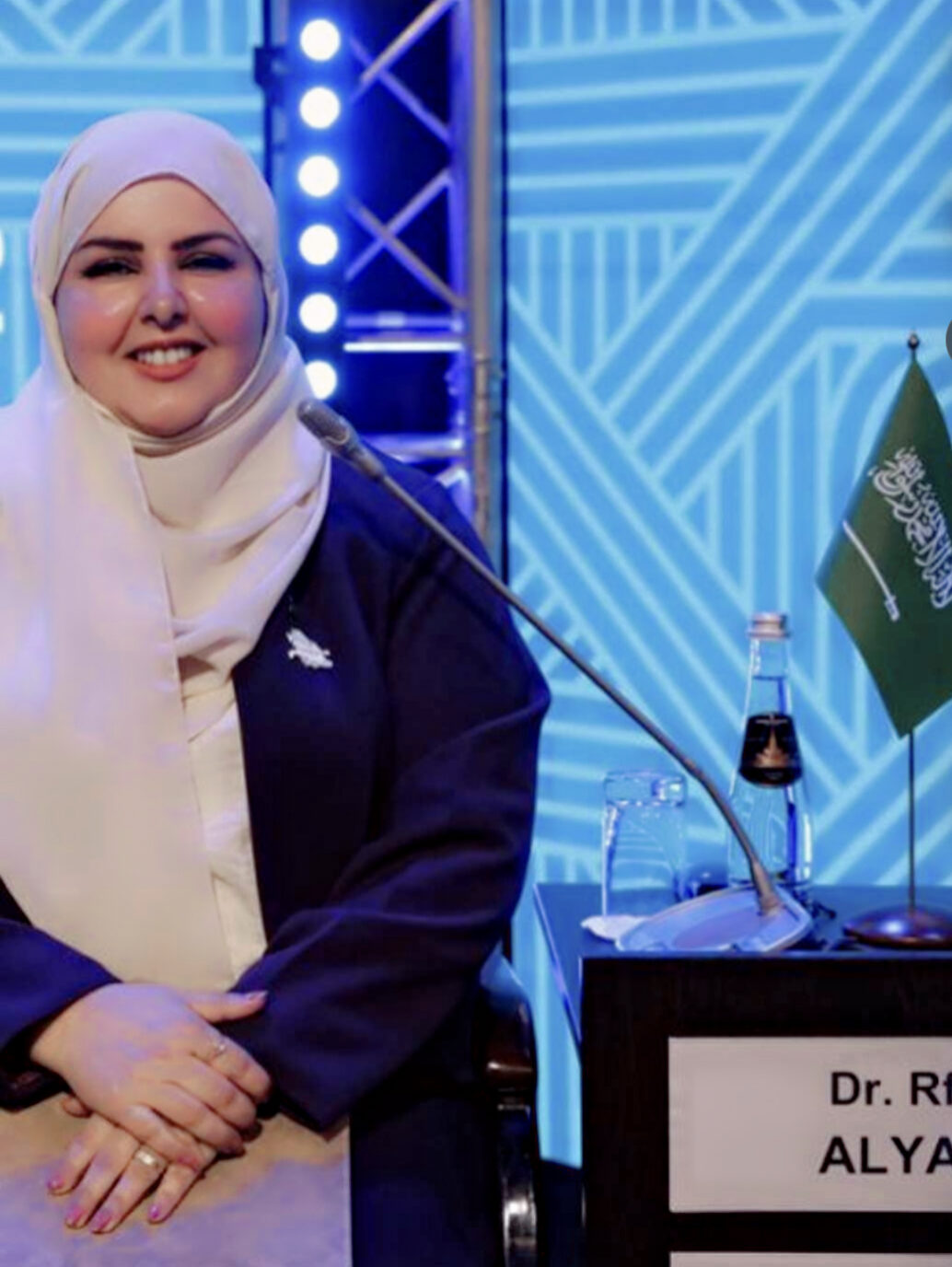
We were interested in learning more about Dr. Rfah Alyami’s entrepreneurial work, so we asked what inspired her to establish Conferencely.org and what vision she has for its future.
Dr. Rfah Alyami: Conferencely.org grew out of a very personal experience in my academic and professional journey.
Over the years, I have attended many conferences, presented research papers, and participated in academic and professional events across different countries. I have always had a genuine passion for conferences because I see them as dynamic spaces where knowledge, people, and ideas come together.
However, I repeatedly encountered the same challenge: information about conferences I had attended, papers I had presented, speakers I had listened to, and experts I wanted to reconnect with was scattered across different websites and online sources. Looking back at a particular conference, even one I had personally attended, could require searching through several different places.
That experience inspired me to create Conferencely.org: a platform designed to bring the conference ecosystem together in one searchable place. The idea is to create an index connecting conferences with their speakers, researchers, experts, leaders, influencers, and the scientific papers and knowledge presented at those events.
I envision Conferencely as more than a conference-discovery platform. I want it to become a living memory of global conferences and knowledge exchange. Users should be able to explore current and past conferences by year, country, field, or geographical location on a map, while also discovering the people and ideas behind them.
Connection is another important part of the vision. Conferences bring together remarkable scientists, experts, industry leaders, policymakers, and influential thinkers, but those connections can easily disappear once an event ends. Conferencely aims to extend the life of those interactions by helping people discover and connect with speakers and experts whose work is relevant to their interests.
Ultimately, my vision is for Conferencely to become a global gateway to conference knowledge — a place where someone interested in the latest developments in science, industry, policy, technology, or innovation can discover not only where conversations are happening, but who is leading them and what new knowledge is emerging from them.
Navigating the Challenges of Innovation
We wanted to understand the challenges Dr. Rfah Alyami sees in innovation, so we asked what challenges organizations can face when implementing new ideas.
Dr. Rfah Alyami: One of the greatest lessons I have learned from studying and working with organizational and educational change is that having a good idea does not guarantee successful implementation.
Organizations are human systems. A new initiative may look excellent on paper but encounter difficulties because people do not understand its purpose, stakeholders were not sufficiently involved in its design, responsibilities are unclear, resources are insufficient, or the organizational culture is not ready for the change.
Resistance to change is often described as a problem, but I believe leaders should look deeper. Resistance can sometimes be valuable information. It may indicate uncertainty, lack of communication, previous negative experiences with change, or legitimate concerns about implementation.
Another common challenge is moving too quickly from idea to large-scale implementation. Organizations can benefit from testing, learning, collecting evidence, and refining an intervention before expanding it.
Leadership therefore plays a critical role. Leaders need to communicate a compelling purpose, create ownership among stakeholders, build capacity, provide appropriate resources, and establish mechanisms for feedback and evaluation.
Most importantly, organizations should develop a culture in which learning is part of implementation. Innovation should not mean expecting every idea to work perfectly the first time. It should mean creating an environment where organizations can experiment responsibly, evaluate results, learn from evidence, and continuously improve.
Advice for the Next Generation of Policy Leaders
We were interested in learning from Dr. Rfah Alyami’s experience, so we asked what advice she would give to those pursuing careers in policy and innovation.
Dr. Rfah Alyami: My first advice would be: stay curious, and never stop learning.
Policy and innovation require more than expertise in one discipline. The problems we face today — in education, technology, sustainability, economic development, and society — increasingly cross traditional boundaries. Learn from research, but also learn from data, technology, organizations, communities, and people whose perspectives differ from your own.
Second, develop the ability to connect evidence with action. Reading research is important, but the real value comes from asking what that evidence means for a decision, an organization, a community, or a policy.
Third, spend time understanding the problem before becoming attached to a solution. Innovation is not about producing the most impressive idea; it is about creating something that genuinely addresses a need.
I would also encourage young professionals to build international perspectives while remaining deeply aware of their own context. My experiences in Saudi Arabia and the United Kingdom, as well as my participation in international academic conferences, have taught me that we can learn enormously from other systems, but successful policies cannot simply be copied. They need to be understood and adapted to the cultural, institutional, and social context in which they will operate.
Finally, I would say: do not be afraid to evolve professionally. My own journey has taken me from science teaching to school leadership, academic research, educational reform, public policy, and now data science, artificial intelligence, and entrepreneurship. I do not see these as separate careers. I see them as different chapters of the same question: How can knowledge be transformed into meaningful change?
That is the question I continue to pursue.