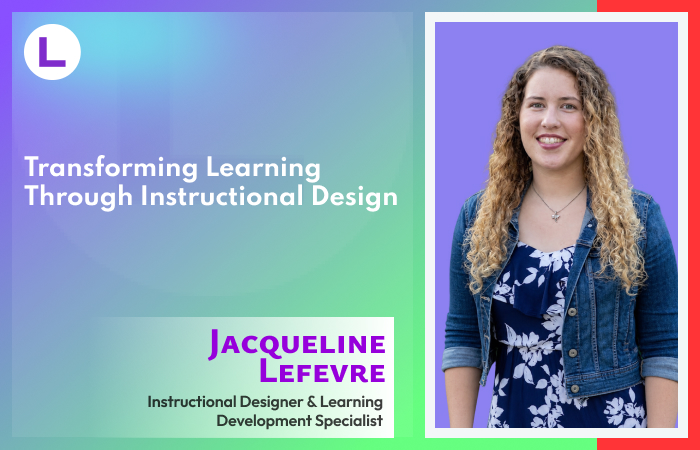
Jacqueline LeFevre has built a career around transforming complex information into engaging, accessible, and meaningful learning experiences. With a foundation in science education and expertise in instructional design, learning and development, and user experience, she brings a unique perspective to helping organizations create learning solutions that drive performance and support diverse audiences.
In this exclusive interview, Jacqueline discusses her journey from the classroom to instructional design, shares insights into modern learning challenges, explores the growing role of technology and AI in professional development, and explains why thoughtful design remains at the heart of effective learning. She also offers valuable advice for aspiring instructional designers looking to make a lasting impact in the field.
From Science Education to Instructional Design
We were interested in learning more about Jacqueline LeFevre’s background and career journey, so we asked her to briefly introduce herself and share her early life and professional path.
Jacqueline LeFevre: I’m an instructional designer and learning and development specialist with a background in science education. I earned my bachelor’s degree in Biology and Broad Field Science with a minor in Spanish and began my career as a high school science teacher.
Teaching gave me an appreciation for the challenge of turning complex information into something that is easily understood and immediately applicable for different types of learners. Over time, I realized that some of the work I enjoyed most happened behind the scenes: designing learning experiences, developing resources, incorporating technology, and finding better ways to help people understand and apply information.
That interest led me into instructional design. Today, I design professional learning experiences that include eLearning, scenario-based learning, simulations, microlearning, videos, assessments, job aids, graphic development, web design, and instructor-led and blended training. My work has allowed me to combine education, technology, visual design, accessibility, and problem-solving while continuing to learn from the subject matter experts and organizations I collaborate with.

Discovering a Passion for Learning Design
We were curious to know what inspired Jacqueline to pursue a career in instructional design and learning development, and what led her to this dynamic field.
Jacqueline LeFevre : I didn’t initially know that “instructional designer” was a career. I knew that I loved teaching and creativity; I was especially drawn to the process of figuring out how someone would engage with information in order to not only understand it, but implement it.
My science background also influenced that interest. Science can be incredibly complex, and knowing something yourself is very different from being able to explain it effectively to someone else. That same challenge exists in instructional design.
What ultimately attracted me to the field was the opportunity to solve learning problems at a larger scale. Instead of asking only, “What content do we need to teach?” I get to ask, “What does this person need to be able to do, what might prevent them from doing it, and what experience or resource would actually help?”
That shift from delivering information to designing for performance is what continues to excite me about the profession.
Shaping Tomorrow’s Leaders Through Education and Mentorship
Designing for Diverse Learners
Creating impactful learning experiences requires both creativity and insight. We asked Jacqueline what she enjoys most about designing learning solutions for diverse audiences.
Jacqueline LeFevre : I enjoy finding the point where complex information becomes clear and relevant.
Learners bring different experiences, abilities, responsibilities, motivations, and levels of prior knowledge into a learning experience. Good design shouldn’t require everyone to learn in exactly the same way or assume that simply presenting information means learning has occurred.
I enjoy determining what learners truly need and then choosing the right approach. Sometimes that is a realistic scenario or software simulation. Other times it might be a visual, short video, job aid, or concise explanation learners can reference at the moment of need.
Accessibility is an important part of that process for me as well. I try to consider accessibility from the beginning rather than treating it as a checklist at the end. Designing for diverse learners often results in clearer, more flexible learning experiences that benefit everyone.
From Content to Performance
As workplace learning continues to evolve, we wanted to learn about some of the key challenges organizations face when developing effective training programs today.
Jacqueline LeFevre : One of the biggest challenges is distinguishing between a content problem and a performance problem. Training courses are often requested because information needs to be communicated, but the format in which the training is presented is the challenge we want an intentional solution for.
Organizations are also navigating limited time, rapidly changing technology, large amounts of information, and learners who need resources that fit naturally into their work. That creates pressure to make training shorter, faster, and more engaging—but “engaging” can easily become confused with simply adding more interactions, animations, or technology.
I regularly ask, “What do we want the learner to do with this information?” An interaction should earn its place by supporting the learning objective, not simply because clicking makes something appear more interactive.
AI adds another interesting dimension. We can now generate content, visuals, audio, questions, and other materials incredibly quickly. That makes instructional judgment even more important. The question is no longer simply what we can create; it is what we should create to support the learner and how we can refine it to be realistic to real-world issues.

Staying Ahead of Learning Trends
With learning technologies and industry trends constantly changing, we were interested in learning how Jacqueline stays current and continues to grow professionally.
Jacqueline LeFevre : I am always reviewing work and posts from my ID community and networking with others on LinkedIn. I regularly share my experiences, offer tips, encouragement, resources, etc. I also love to experiment with new tools. When I encounter a new technology, I like to explore what it can actually contribute to a learning experience rather than adopting it simply because it is new.
I regularly work with tools such as Articulate Storyline and Rise, multimedia and visual-design platforms, LMS technology, and generative AI tools including ChatGPT, Claude, and Microsoft Copilot. I also follow other instructional designers, accessibility professionals, learning organizations, and technology communities to see how practices are evolving.
AI has made continuous learning particularly important. I use it to support tasks such as brainstorming, early drafting, synthesizing information, developing assessment ideas, accessibility work, and exploring visual concepts. With every generation I refine, edit, and design with my learners in mind.
Technology changes quickly. Principles such as understanding your learner, aligning experiences with objectives, reducing unnecessary cognitive load, designing accessibly, and evaluating whether learning transfers to performance will remain constant priorities in efficient and meaningful learning.
Designing for Better Learning Experiences
User experience has become an essential part of effective learning design. We asked Jacqueline how UX influences learner engagement, knowledge retention, and overall outcomes.
Jacqueline LeFevre : Learners experience the design before they experience the content.
If navigation is confusing, instructions are unclear, accessibility barriers exist, screens are overloaded, or learners have to figure out how an interaction works before they can engage with the actual concept, then their motivation, retention, and application of learning can be lost.
That is why I see user experience (UX) and instructional design intertwined. Good learning UX should make the experience feel intuitive and accessible, so the learner can focus on the task.
It also means making intentional decisions about hierarchy, navigation, consistency, readability, feedback, accessibility, and interaction design is incredibly essential during development. More interaction does not automatically create more engagement. A purposeful scenario that asks someone to make a meaningful decision can be far more valuable than several interactions that simply ask them to click to reveal information.
The end goal is to determine what interaction makes an effective teaching solution for a problem that is lack of skill versus lack of knowledge.
Redefining Mental Health Care Through Trust and Connection
Advice for Aspiring Instructional Designers
Finally, we asked Jacqueline what advice she would offer to professionals looking to enter and succeed in the instructional design field.
Jacqueline LeFevre : My biggest advice is to connect with others and share your experiences. This is a diverse field with endless titles and positions, so you are sure to find a perfect fit.
Knowing Storyline, Rise, an LMS, or the latest AI tool can certainly help you get opportunities, but tools will continue to change. The more valuable skill is being able to look at a problem, understand the learner and business need, determine whether training is appropriate, design an effective solution, and explain why you made those decisions.
Having a portfolio/website to provide credibility to your skills, design process, and creativity is useful when applying and interviewing to easily have something that professionally showcases your resume. The subject of your work is less important than your ability to show your thinking. Explain the problem, audience, constraints, learning objectives, design decisions, accessibility considerations, feedback you received, and how the solution evolved.
I’d also encourage new instructional designers to become comfortable with collaboration and iteration. You will work with people who know far more about their subject matter than you do. Your role isn’t to become the expert—it’s to partner with experts and transform what they know into something other people can understand and apply.
Finally, stay curious. This field sits at the intersection of learning science, technology, communication, accessibility, visual design, business, and human behavior. You never really finish learning how to be an instructional designer—and I think that’s one of the best parts of the profession.