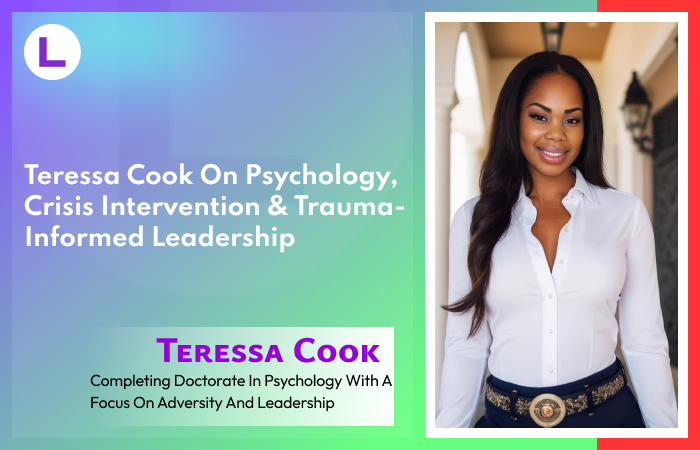
In today’s complex and high-pressure environments, the intersection of psychology, leadership, and crisis intervention has become more critical than ever. As organizations and individuals navigate increasing levels of stress, uncertainty, and rapid change, the need for trauma-informed, human-centered approaches is reshaping how systems are designed and led.
Teressa Cook brings a unique and deeply informed perspective to this evolving space. With a strong foundation in behavioral science and a focus on crisis intervention, her work explores how adversity, leadership, and organizational systems interact to influence both individual outcomes and collective resilience. Currently pursuing a Doctorate in Human and Organizational Psychology with a concentration in Leadership Psychology and Adversity, she is dedicated to bridging the gap between human experience and system-level effectiveness.
In this interview, Teressa Cook shares insights into her journey, the experiences that shaped her approach, and her perspective on leadership in high-stress environments. From trauma-informed systems to the future of resilience-driven organizations, her views offer valuable guidance for professionals seeking to build more supportive, effective, and sustainable systems.
Psychology and Crisis Intervention Journey
We were interested in learning more about Teressa Cook’s background, so we asked her to share insights into her journey into psychology and crisis intervention.
Teressa Cook: I am currently pursuing a doctorate in Human and Organizational Psychology with a concentration in Leadership Psychology and Adversity. My work integrates behavioral science, crisis intervention, and holistic wellness to support individuals and systems navigating high-stress and high-impact environments.
My journey into psychology and crisis intervention was shaped through lived experience and direct exposure to adversity, instability, and gaps within care systems. These early insights created a deeper curiosity about human behavior—not just at the individual level, but within the environments that influence outcomes. That curiosity evolved into a focused commitment to understanding how a crisis emerges, how it is managed, and how systems can either perpetuate harm or facilitate recovery.
Teressa Cook on Adversity and Leadership
To understand her academic focus, we asked Teressa Cook what led her to center her doctorate on adversity and leadership.
Teressa Cook: The decision to focus on adversity and leadership stems from the recognition that adversity is rarely isolated—it is often shaped, intensified, or mitigated by leadership and organizational systems. Many traditional leadership models emphasize performance and output, while overlooking psychological safety, stress regulation, and human sustainability.
This doctoral focus examines how leadership functions as a regulatory force within systems. It explores how leaders influence emotional climate, decision-making under pressure, and the long-term resilience of individuals and organizations. By studying adversity through a leadership lens, the work aims to bridge the gap between human experience and organizational effectiveness.
Teressa Cook on Crisis and Leadership
To understand the influence of hands-on experience, we asked Teressa Cook how her work in crisis intervention has shaped her leadership perspective.
Teressa Cook: Experience in direct crisis intervention has reframed leadership as an active, moment-to-moment process rather than a positional role. In crisis environments, effectiveness is not defined by title, but by the ability to stabilize, assess, and respond under pressure.
This work highlights the importance of emotional regulation, situational awareness, and clear communication. It also reinforces that leadership directly impacts the nervous system of a team or environment—either contributing to escalation or supporting de-escalation.
Crisis intervention has strengthened the perspective that trauma-informed leadership is essential. Without it, systems risk misinterpreting behavior and reinforcing instability. With it, leadership becomes a mechanism for structure, safety, and recovery.
Challenges in Trauma-Informed Organizations
To explore organizational challenges, we asked Teressa Cook what key obstacles companies face when implementing trauma-informed systems.
Teressa Cook: One of the most common challenges is surface-level adoption. Organizations may integrate trauma-informed language without making the deeper structural and cultural changes required for meaningful implementation.
There is also frequent resistance rooted in misunderstanding. Trauma-informed approaches are sometimes perceived as reducing accountability, when in practice they require greater clarity, consistency, and intentionality.
Additionally, organizations often overlook the role of leadership regulation. Without addressing stress, burnout, and reactivity at the leadership level, trauma-informed initiatives can become inconsistent and difficult to sustain.

Real-World Lessons in Crisis Support
We were curious about the moments that defined her work, so we asked Teressa Cook to share an experience that shaped her approach to crisis support.
Teressa Cook: A pivotal experience involved supporting an individual in acute distress whose behavior was initially interpreted as noncompliant. Through a trauma-informed lens, the behavior was recognized as a stress response rather than intentional defiance.
By shifting the approach toward stabilization, emotional regulation, and structured communication, the interaction de-escalated and became more collaborative. The outcome demonstrated that when behavior is understood within context, interventions become more effective and less reactive.
This experience continues to reinforce the principle that behavior is a form of communication, particularly in high-stress environments.
Future of Trauma-Informed Practices
We were interested in the future of this field, so we asked Teressa Cook how trauma-informed practices are likely to evolve across industries.
Teressa Cook: Trauma-informed practices are becoming increasingly relevant across industries, including healthcare, education, corporate environments, and behavioral health systems. There is growing recognition that psychological safety and emotional regulation directly impact performance, retention, and organizational culture.
Future developments will likely include greater integration of neuroscience, data-informed decision-making, and interdisciplinary approaches that combine psychology, wellness practices, and leadership strategy.
Trauma-informed leadership is expected to become a standard rather than a specialization, particularly as organizations adapt to increasingly complex and high-pressure environments.
Teressa Cook on Building Resilient Systems
To explore practical guidance, we asked Teressa Cook what advice she would share with professionals seeking to create stronger and more resilient systems.
Teressa Cook: Develop awareness, but prioritize application. Understanding concepts is only effective when it translates into consistent action.
Strengthen the ability to remain regulated under pressure. Leadership effectiveness is closely tied to how individuals manage stress within themselves and within systems.
Focus on structure and consistency. Clear expectations, predictable processes, and accountability create environments that support both performance and well-being.
Lastly, approach resilience as a system-level outcome. Sustainable resilience is built through environments that balance challenge, support, and recovery—not through pressure alone.
Final Thoughts on Trauma-Informed Leadership
In conclusion, Teressa Cook’s insights highlight a critical shift in how leadership and systems must evolve to meet the demands of today’s high-stress and rapidly changing environments. By integrating psychology, crisis intervention, and trauma-informed practices, she emphasizes the importance of understanding human behavior within context rather than reacting to it in isolation. Her perspective underscores that resilient and effective systems are built not only on strategy and performance but also on psychological safety, emotional regulation, and intentional leadership. As organizations continue to adapt, her approach offers a clear and practical framework for creating environments that support both well-being and sustainable success.
Also Read: