
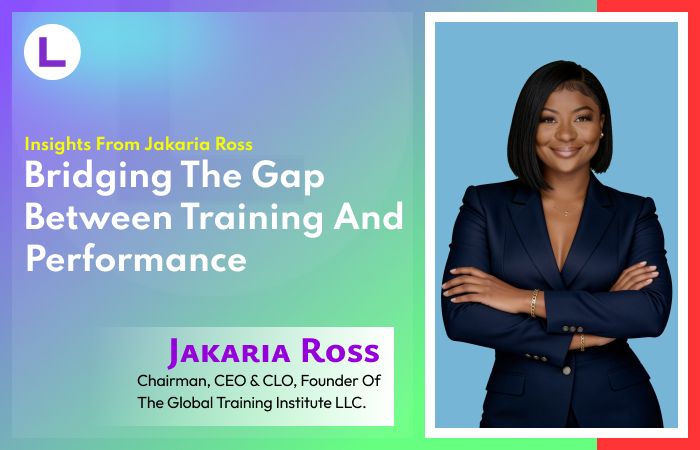
In today’s rapidly evolving business landscape, the gap between training and real performance has become more evident than ever. Jakaria Ross stands at the forefront of addressing this challenge, bringing a strategic and science-driven approach to leadership, HR, and workforce development. As the Founder, Chairman, and Chief Learning Officer of The Global Training Institute LLC, she focuses on transforming traditional learning into measurable business impact.
In this interview, Jakaria Ross shares insights into her journey, the vision behind her organization, and how she is redefining training through neuroscience, performance alignment, and practical execution. She also discusses the key challenges organizations face today and offers valuable perspectives on building adaptable systems and high-performing teams.
From Learning Design to Leadership and Workforce Impact
We were interested in learning more about Jakaria Ross’s professional journey, so we asked her to briefly introduce herself and her path into leadership, HR, and training.
Jakaria Ross: I am the Founder, Chairman, and Chief Learning Officer of The Global Training Institute LLC, where I focus on designing performance-driven learning systems that directly impact business outcomes. My journey began in instructional design and evolved over years of working in complex, fast-paced environments, where I consistently saw a gap between training and actual performance. That experience shaped my leadership philosophy—training is not about content delivery; it is about measurable behavior change. Today, my work sits at the intersection of leadership, HR, and operational performance, helping organizations build systems that prepare their workforce to execute at a high level.
Bridging the Gap Between Training and Performance
To explore the story behind her organization, we asked Jakaria Ross what inspired her to establish The Global Training Institute LLC and the need she identified in the market.
Jakaria Ross: The Global Training Institute LLC was founded to address a critical gap in the market: organizations were investing heavily in training, but not seeing a return in performance, productivity, or business outcomes. Most training programs are built around information, not execution. I created GTA to shift that paradigm. We design learning as a business intervention—aligned to KPIs, grounded in real-world scenarios, and built to drive measurable results. The gap we fill is workforce readiness—ensuring employees are not just trained, but fully equipped to perform in their roles from day one.
Applying Neuroscience to Learning and Development
We were curious about the role of science in her work, so we asked Jakaria Ross how neuroscience shapes her approach to training and developing people.
Jakaria Ross: Neuroscience plays a central role in how we design learning experiences. We focus on how people actually retain, process, and apply information. This means reducing cognitive overload, using spaced learning, incorporating emotional engagement, and designing for real-world application. Instead of overwhelming learners with content, we structure learning to mirror how the brain builds and reinforces habits. The result is more effective retention, faster skill acquisition, and stronger transfer of learning into performance.
Key Challenges in Workforce Development Today
To explore current challenges in the industry, we asked Jakaria Ross what issues organizations commonly encounter in workforce development.
Jakaria Ross: The most common challenge is misalignment. Training is often disconnected from business strategy, resulting in low impact. Organizations also struggle with over-reliance on content-heavy programs that do not translate into behavior change. Another major issue is the lack of measurement—many companies cannot clearly define or track the impact of their training initiatives. Finally, there is a growing gap between the pace of business and the speed at which employees are prepared to perform. Without a structured, performance-based approach, organizations fall behind.

Aligning Training with Measurable Business Outcomes
We were interested in understanding her strategic approach, so we asked Jakaria Ross how she helps organizations align training with real business outcomes.
Jakaria Ross: We start by identifying the performance problem, not the training request. From there, we map learning directly to business KPIs and define what success looks like in measurable terms. Our approach includes scenario-based design, role-specific application, and integrated assessments that reflect real job tasks. We also build evaluation frameworks that track impact at multiple levels, from behavior change to operational results. This ensures training is not just completed, but actually drives performance improvement.
Building Adaptability Through Systems and Strategy
We were curious about her mindset in times of change, so we asked Jakaria Ross how she maintains adaptability in an ever-evolving workplace.
Jakaria Ross: Adaptability comes from building systems, not one-off solutions. We use agile, iterative design approaches that enable us to continuously refine and improve learning experiences. We also stay closely connected to industry trends, emerging technologies, and workforce shifts—particularly in AI and automation. Most importantly, we maintain a strong feedback loop with clients and learners, which allows us to adjust quickly and remain aligned with real business needs.
Leadership Strategies for High-Performance Teams
We were interested in her perspective on leadership, so we asked Jakaria Ross what advice she would give to leaders aiming to build high-performing teams.
Jakaria Ross: High-performing teams are built through clarity, accountability, and capability. Leaders must clearly define expectations, align their teams to meaningful outcomes, and ensure individuals have the skills to execute. Training should be practical, continuous, and directly tied to performance. Just as important, leaders must create an environment of trust and ownership in which individuals feel responsible for results. When capability and accountability are aligned, performance follows.
Final Thoughts on Performance-Driven Learning
In conclusion, Jakaria Ross’s work highlights a clear shift in how organizations must think about learning and development in today’s competitive environment. By moving beyond traditional, content-heavy training and focusing instead on performance, neuroscience, and measurable outcomes, she presents a model that directly connects learning to business success. Her approach through The Global Training Institute LLC underscores the importance of aligning workforce development with real operational needs, ensuring employees are not only trained but truly prepared to perform. As businesses continue to navigate rapid change, her insights offer a practical roadmap for building stronger, more adaptable, and high-performing teams.
Also Read: