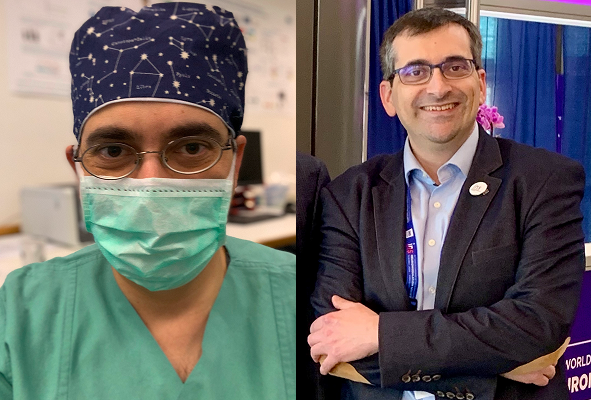
Georgios Matis is a neurosurgeon whose work bridges science, philosophy, and patient-centered innovation. With an international background and a deep commitment to advancing neuromodulation, he brings a unique perspective to the treatment of chronic pain and spasticity. We sat down with Dr. Matis to learn more about the personal journey that shaped his career, the philosophies that guide his decisions, and his vision for the future of neuromodulation.
Georgios Matis: Early Life Journey
We were curious about Georgios Matis’s background, so we asked him to share a bit about his early life.
Georgios Matis: I was born with the conviction that medicine is not only a science but also an art of healing, an interplay of reason and compassion. My journey began in Greece, surrounded by a culture deeply rooted in philosophy and humanism. It was there that I absorbed the wisdom of thinkers like Aristotle, who wrote that “the purpose of life is not merely to live, but to live well.” This pursuit of excellence and meaning shaped my path into neurosurgery, a discipline that demands precision, vision, and a profound respect for human dignity.
Throughout my education and early career, I sought knowledge not confined by national borders. Today, I hold licenses to practice in Greece, Cyprus, Germany, and Switzerland; each country enriching me with diverse perspectives and traditions in medicine. This international exposure has been instrumental in shaping my clinical approach and my dedication to building bridges between cultures, colleagues, and patients.
I am honored to serve as an Editorial Board Member of Neuromodulation: Technology at the Neural Interface, the official journal of the International Neuromodulation Society (INS), and as Co-Chair of the INS Medical and Public Education and Engagement Committee. In addition, I carry the responsibility of Secretary of the German Society for Neuromodulation. These roles allow me to contribute not only to patient care but also to the global scientific dialogue that defines the future of neuromodulation. In September, I will begin a new chapter as the head of the Chronic Pain / Spasticity – Neuromodulation Unit at Hygeia Hospital in Athens, Greece, a place I envision becoming a beacon of excellence for Southeastern Europe and beyond.
Inspired by Healing and Harmony
We wanted to understand what led Georgios Matis to specialize in neuromodulation and the surgical treatment of chronic pain and spasticity, so we asked him what inspired this particular focus in his medical career.
Georgios Matis: The inspiration to devote my life to neuromodulation arose from a simple yet profound observation: chronic pain and spasticity do not only erode the body, but they consume the soul. To witness a patient who is trapped in suffering and to then see them regain function, dignity, and hope through therapies such as spinal cord stimulation or intrathecal ziconotide is nothing short of transformative. As Plato once suggested, medicine should aim at “restoring harmony” and neuromodulation embodies precisely that: a rebalancing of the disrupted symphony of the nervous system.
Over the years, I have seen technologies evolve from conventional tonic stimulation to sophisticated paradigms like BurstDR, FAST, DTM, and closed-loop systems that adjust in real time based on ECAPs. The ability to program devices remotely, to stimulate multifidus muscles, and to employ artificial intelligence in tailoring treatments, all these innovations have made the field not only exciting but also deeply human. They allow us to move beyond treating symptoms into restoring lives.
What drew me most, however, was the philosophical depth of this work. Michel Foucault once wrote that medicine is about “the care of the self.” Neuromodulation is the epitome of that idea: a therapy where precision engineering meets the intimate fragility of human experience. It was this synthesis between technology, philosophy, and empathy that made neuromodulation my calling.
Driven by Restoring Life’s Meaning
Curious about what truly motivates Georgios Matis in his work, we asked him what drives him most when it comes to helping patients achieve a better quality of life.
Georgios Matis: What drives me is not merely the alleviation of pain, but the restoration of meaning. Chronic pain often reduces life to survival, stripping away the possibility of joy, creativity, and connection. Inspired by Viktor Frankl’s insight that “those who have a ‘why’ to live can bear almost any ‘how,’” my role as a neuromodulation specialist is to help patients rediscover their “why.” Each patient is a narrative interrupted by suffering, and my task is to offer them the possibility of rewriting their story.
The technical means at our disposal are remarkable. Whether it is closed-loop spinal cord stimulation, multifidus stimulation for axial back pain, or intrathecal ziconotide therapy for otherwise intractable cases, the technology is only a tool. What matters is how we use it to guide patients back toward function and dignity. When a patient tells me they can once again walk, garden, or care for their loved ones, I am reminded that neuromodulation is not about electricity or chemistry; it is about humanity.
My motivation is also philosophical. As Seneca said, “It is not that we have a short time to live, but that we waste much of it.” For patients in chronic pain, time becomes imprisoned in suffering. Restoring quality of life means liberating time itself, returning to them the possibility to live fully. That is what fuels me each day.
Navigating Complexity and Ethical Challenges
To gain insight into the complexities of his field, we asked Georgios Matis about the biggest challenges he faces when treating chronic pain through surgical methods.
Georgios Matis: The greatest challenge lies in the complexity of pain itself. Pain is not only a physiological signal but also a deeply personal and cultural phenomenon. Each patient brings a unique history, biology, and psychology to the operating table. Understanding this multidimensionality requires humility and constant learning. In the words of Hippocrates, “It is more important to know what sort of person has a disease than to know what sort of disease a person has.”
Another challenge is the rapid evolution of technology. With the advent of closed-loop stimulation, multiple waveform options, and remote programming capabilities, the clinician must remain not only a surgeon but also a lifelong student of bioengineering, data science, and even artificial intelligence. Integrating these advances responsibly, without losing the human connection, is perhaps the greatest test of modern neuromodulation.
Finally, there is the challenge of access. Many patients worldwide still lack availability of advanced therapies such as ziconotide or next-generation spinal cord stimulation systems. This disparity is not merely a technical problem but a moral one. The philosopher Immanuel Kant urged us to treat humanity always as an end and never merely as a means. Our task as physicians is to ensure that no patient is excluded from therapies that can transform their existence.
Innovating When Conventional Treatments Fail
We were interested in how Georgios Matis navigates difficult cases, so we asked him how he approaches situations where conventional treatments have failed to provide relief.
Georgios Matis: When conventional treatments fail, I see not a dead end but an invitation to innovation. Pain is a labyrinth, and sometimes one must look for hidden doors. Multifidus stimulation, for instance, is offering new solutions for patients with mechanical back pain resistant to other therapies. Intrathecal ziconotide provides relief for those who cannot tolerate or respond to opioids. Closed-loop spinal cord stimulation allows us to adapt therapy dynamically, ensuring consistent efficacy where older methods might falter.
My approach is deeply collaborative. I involve patients in every step, ensuring they understand both the promise and the limitations of neuromodulation. In this sense, I embrace the Socratic method: asking questions, listening deeply, and guiding patients to co-create the path forward. It is not a paternalistic model of medicine but one of partnership.
Moreover, I draw inspiration from Spinoza, who wrote that “the endeavor to persist in one’s own being is the very essence of man.” My responsibility is to honor that endeavor by offering tools that allow patients to persist, to endure, and ultimately to thrive even when conventional medicine has failed them.
The Future of Neuromodulation
Looking ahead, we asked Georgios Matis where he sees the field of neuromodulation heading in the next five to ten years.
Georgios Matis: The coming decade will witness neuromodulation merging with artificial intelligence and digital health in ways we could only dream of before. Closed-loop systems will evolve into fully adaptive platforms, guided not only by neural signals but also by predictive analytics. Remote programming will expand accessibility, allowing patients in rural areas or underserved countries to receive world-class care without leaving their homes.
Waveform diversity (FAST, BurstDR, DTM, and beyond) will no longer be a matter of trial and error but of personalization guided by data-driven algorithms. Multifidus stimulation will become a standard option for chronic mechanical low back pain, shifting paradigms in spine care. Intrathecal therapy with agents like ziconotide will also see a renaissance, especially as we refine precision dosing and long-term management strategies.
Philosophically, I believe neuromodulation will fulfill Nietzsche’s call to “become who you are.” By restoring function and dignity, we are not simply treating disease; we are enabling patients to become their fullest selves. The future of neuromodulation is not just technological—it is profoundly existential.
Bridging Gaps in Pain Management
We were curious to know Georgios Matis’s perspective on the global state of pain management, so we asked if there are any areas he feels deserve more attention worldwide.
Georgios Matis: Yes, there are significant gaps. First, education: far too many physicians worldwide remain unaware of neuromodulation’s potential, leaving patients trapped in cycles of opioids or ineffective conventional therapies. This is why I dedicate time as Co-Chair of the INS Medical and Public Education and Engagement Committee to raise awareness and ensure knowledge translates into practice.
Second, equity of access remains a critical issue. Advanced therapies like closed-loop spinal cord stimulation or ziconotide are often available only in select countries or for select patients. As John Stuart Mill argued, “Genuine worth should not depend on the accident of birth.” We must strive for a system where geography and socioeconomic status do not determine whether one can live free from pain.
Lastly, there is a need to integrate philosophy and narrative into pain care. As I emphasized in my book From Surgeons to Storytellers: Building Bridges with Patients in Neuromodulation, medicine is not merely about intervention but also about storytelling, helping patients reconstruct meaning. Pain management globally needs to embrace not just the physical, but also the narrative, psychological, and existential dimensions of suffering.
A Filmmaker’s Heart in Surgery
Wondering what path he might have taken outside of medicine, we asked Georgios Matis what career he would have pursued if he weren’t a neurosurgeon — and why.
Georgios Matis: If I had not chosen neurosurgery, I believe I would have become a filmmaker. Like surgery, cinema demands precision, vision, and the ability to tell a story that moves the human soul. In fact, every patient encounter feels like a script: there is conflict (pain), a protagonist (the patient), a supporting character (the physician), and a resolution (restoration of dignity).
As a Hollywood scriptwriter, I would have sought to create narratives that reflect resilience, transformation, and the triumph of the human spirit. Much like neuromodulation, film is about altering perception, shifting perspectives, and illuminating hidden truths. Both require empathy and emotional intelligence, the ability to sense the invisible threads that connect us.
In some sense, I already live in this duality. My recent book From Surgeons to Storytellers embraces precisely this idea: that surgeons must also be narrators, weaving together science and story to help patients reimagine their futures. Medicine and cinema are two sides of the same coin: both are about guiding humanity from darkness into light.
Guided by Wisdom and Purpose
Curious about the guiding principles behind his work and life, we asked Georgios Matis if there’s a philosophy, quote, or principle outside of medicine that influences his decisions.
Georgios Matis: I believe in the synthesis of wisdom across eras. Socrates reminded us that “the unexamined life is not worth living.” Marcus Aurelius taught us that “the impediment to action advances action. What stands in the way becomes the way.” And Nietzsche declared, “He who has a why to live can bear almost any how.”
If I may construct my own guiding principle from these, it would be this: Live examined, act with courage, and endure with purpose; transforming obstacles into pathways toward meaning.
This philosophy guides not only my clinical decisions but also my personal life. It reminds me that challenges are not detours but the road itself. It shapes the way I lead, the way I write, and the way I envision the future of neuromodulation: as a field where examination, courage, and purpose converge to transform suffering into strength.
Advice for Future Neuromodulation Specialists
Thinking about the next generation of specialists, we asked Georgios Matis what advice he would offer to doctors aspiring to specialize in neuromodulation.
Georgios Matis: My advice is to enter this field not only with your hands but with your heart and your mind. Neuromodulation is a discipline where engineering meets empathy, and where philosophy meets science. It requires technical mastery, but also the humility to listen, the courage to innovate, and the wisdom to remain patient-centered.
I would urge young doctors to embrace lifelong learning. Technologies such as closed-loop systems, artificial intelligence, multifidus stimulation, and intrathecal therapies are evolving rapidly. Staying relevant means being open to constant growth. But never forget, as Aristotle said, that “educating the mind without educating the heart is no education at all.”
Finally, I would encourage them to cultivate a global perspective. Engage with societies like the INS or the German Society for Neuromodulation, read widely, write, and contribute. My own path, serving on editorial boards, writing books, and soon leading the Hygeia Hospital Unit in Athens, has been defined by collaboration and vision. Neuromodulation is not just a specialty; it is a calling. And like all true callings, it demands dedication to something greater than oneself.
Also Read:
Preity Üpala: Inspiration Behind The Omnia Group
Building a Career with Heart and Hustle — Dil Bahadur Bhomjan’s Story
From philosophy to influence: how Rodolfo Belcastro is shaping global narratives across finance, policy, and public affairs
Inside Lea Jabre’s Mission to Raise Awareness for Rare Diseases